
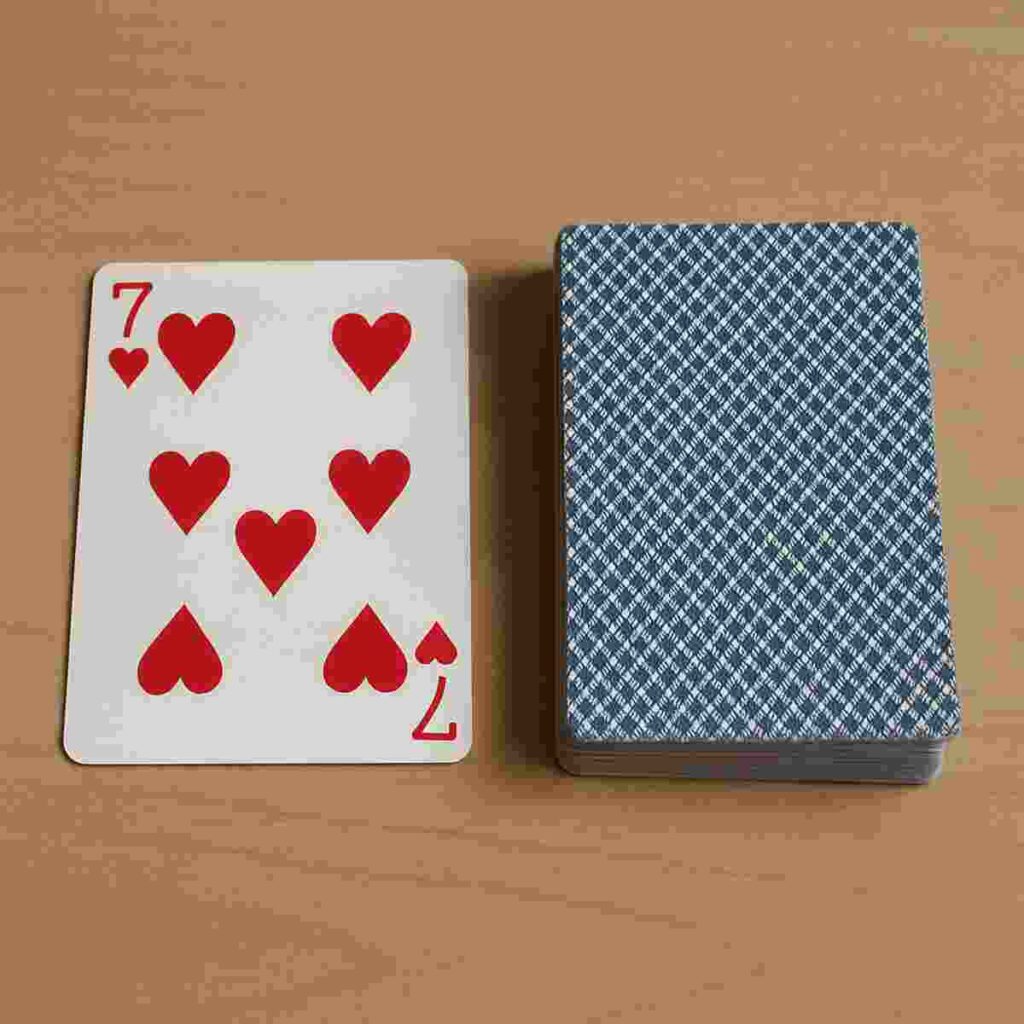
Have a deck of cards but tired of complicated rules? If you’re looking for a game that anyone can learn in less than a minute, welcome to Higher or Lower. It’s one of the simplest card games for two people you will ever find. Playing the hi-lo card game only requires three basic items. To know more, check out kreolorseychelles.com
First, gather your materials. You just need:
- A standard 52-card deck.
- At least two people.
- A table or other flat surface.
In this game, there are two clear roles. The Dealer is the person who shuffles the deck and flips over the cards. The Player is the person who makes the guess. One of you handles the cards, and the other does the guessing.
So, what is the goal? Your one and only objective is to correctly guess if the next card in the deck will be higher or lower than the card you can see on the table. For example, if the Dealer has a 7 showing, the Player just says “Higher” or “Lower.” Get the guess right, and you win the round.
The Most Important Rule: Is Ace High or Low?
Before the first guess, we need to settle the most common point of confusion in any card game. When it comes to the question of is ace high or low in hi-lo, the answer is simple: for this game, Aces are always high. This makes the Ace the most powerful card in the deck, beating even a King. Getting this one rule right is the key to the entire game.
Here is the complete card ranking order from highest to lowest. You don’t need to memorize it; just use it as a guide.
- Ace (Highest)
- King
- Queen
- Jack
- 10, 9, 8, 7, 6, 5, 4, 3
- 2 (Lowest)
Finally, what about the suits (Hearts, Diamonds, Spades, Clubs)? These basic rules for the high low card game make it easy: suits don’t matter at all. A 9 of Hearts and a 9 of Spades are considered to have the exact same value. All that matters is the rank of the card itself. With the card ranks clear, let’s walk through your first round.
How to Play Your First Round: A Step-by-Step Guide
The higher or lower card game is built around a simple, repeating loop. To start a round, the dealer places the top card from the shuffled deck face-up on the table for everyone to see. This single card is the foundation for your guess.
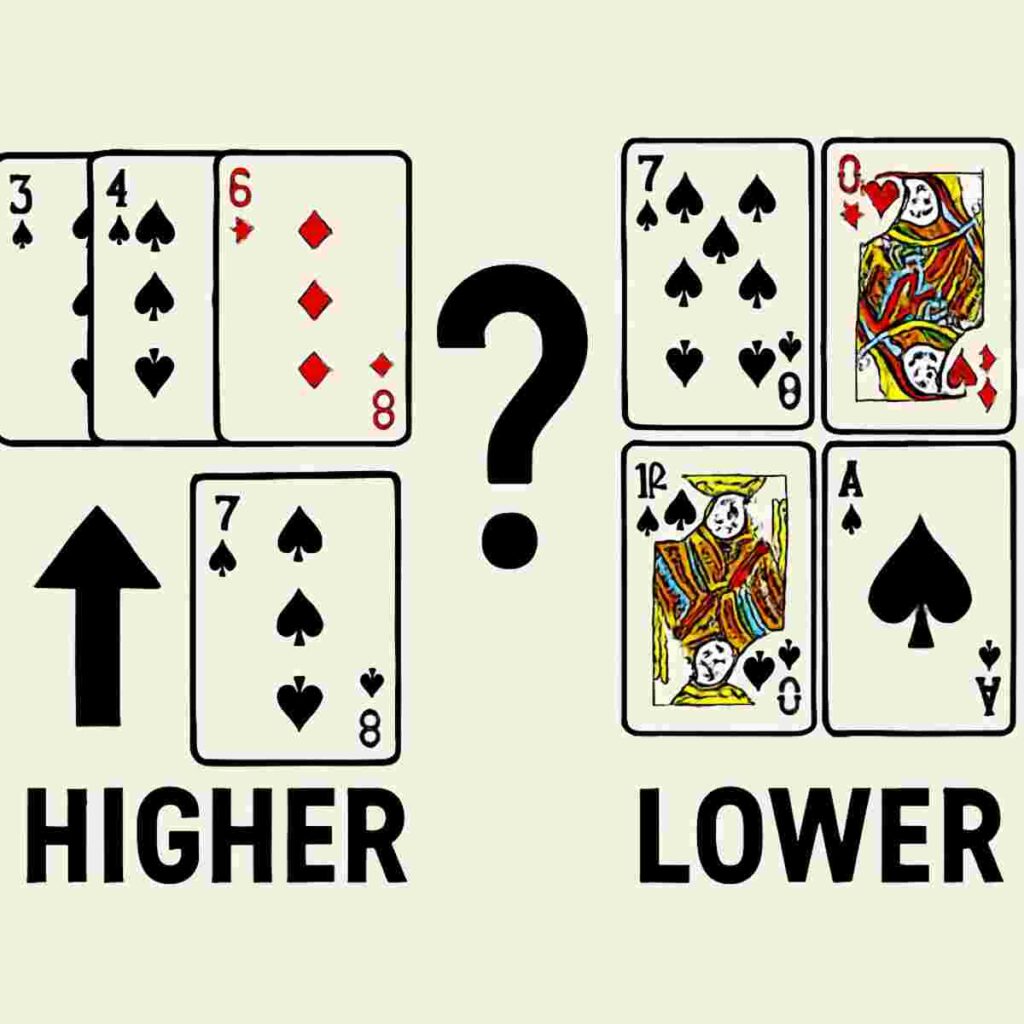
Looking at that face-up card, the player whose turn it is must make a simple prediction. Will the next card off the top of the deck be higher or lower in value? Let’s say the card is a 7. You’d weigh your chances and announce your guess out loud—either “Higher” or “Lower.” It’s a straightforward choice with no other options.
Once your guess is locked in, the moment of truth arrives. The dealer turns over the next card and places it beside the first one. If the first card was a 7 and you guessed “Higher,” seeing a Queen means you were correct! If you had guessed “Lower” and a 3 appeared, you would have also been right. An incorrect guess is just the opposite.
That’s it! You’ve just completed one full round. This quick cycle of deal, guess, and reveal is what makes this one of the most easy to learn card games imaginable. You simply repeat the process for each turn. This raises an important question: what happens if the second card is the exact same rank as the first?
What Happens in a Tie? The Simplest Way to Keep the Game Moving
It’s bound to happen sooner or later. The dealer puts down a Jack, you confidently guess “Lower,” and the very next card is… another Jack. So, what happens? For speed and simplicity, the most common and beginner-friendly rule is this: a tie counts as a loss for the player. Your guess wasn’t technically higher or lower, so the dealer wins the round. This keeps the game moving without any arguments.
This approach is a core part of the standard rules for high low card game because it ensures every round has a clear outcome. Rather than worrying about the odds of a tie, the important thing for a fast, fun game is to have a rule ready. Remembering that a tie is a loss is one of the easiest hi-lo card game rules to learn, ensuring you can get right back to the action.
Once you’re comfortable with the basics, you can introduce a fun twist. Some players prefer to treat a tie as a “push.” This means nobody wins or loses that round; the guess simply carries over to the next card. For example, if you guessed “Lower” on a Jack and another Jack came up, your “Lower” guess would now apply to the third card drawn. For now, stick with the “tie is a loss” rule to keep things simple. Winning rounds is fun, but you still need a way to decide the overall winner.
From Rounds to Victory: How to Decide an Overall Winner
Winning a single round is exciting, but the real fun comes from deciding an overall champion. The easiest way to do this is with a simple point system. For every correct “Higher” or “Lower” guess, the player earns one point. If the player is wrong or if there’s a tie, the dealer gets the point instead. This method is a core part of the standard rules for high low card game, ensuring that keeping score is just as simple as playing a round.
Before dealing the first card, your group should agree on the finish line. A common goal is to be the first person to reach 10 points. This works perfectly whether you’re playing with two people or more. Players simply take turns guessing against the dealer. With this setup, the best high low game strategy for winning isn’t about complex math; it’s about staying focused and having a little luck on your side.
If you prefer a more dramatic, high-stakes finish, try playing for a winning streak. In this popular variation, the first person to get a set number of correct guesses in a row—say, five—wins the entire game instantly. The catch is that a single wrong guess sends your streak crashing back to zero, adding a thrilling tension to every card flip. This flexibility is what makes the game so great and is the same foundation used for other popular variations.
Variation 1: The Famous High Low Drinking Game
Easily the most famous twist on this classic is the High Low drinking game. If you’re looking for a social activity that requires zero setup time, this is it. The high low drinking game rules add a simple consequence to the base game: if you guess incorrectly, you take a drink. For example, if the card on the table is a Queen and you optimistically guess “Higher,” you’d take a drink when the dealer inevitably flips over a lower card, like a 7.
To make things more interesting, you can introduce a fun rule for ties. While a tie normally counts as a wrong guess for the player, this version can flip the script. If the cards are the same rank (e.g., a 5 is followed by another 5), the dealer has to take a drink instead of the player. This simple change adds a splash of unpredictability and keeps everyone engaged.
When playing in a group, the game flows best when the “dealer” role rotates. The easiest way to manage this is to pass the deck. After a player guesses incorrectly and takes their drink, they become the new dealer for the next person in the circle. This cycle ensures no one gets stuck dealing for too long, which is what makes it one of the most balanced and simple card games for a party setting.
With its quick pace and minimal rules, this variation is a perfect card game to play when bored or looking for a social icebreaker. However, if you enjoy the pressure of getting it right but prefer a non-drinking challenge, you’ll love testing your luck with the “Streak Challenge.”
Variation 2: Test Your Luck with the “Streak Challenge”
If you love the thrill of guessing correctly but want to raise the stakes, the “Streak Challenge” is for you. In this version, your turn doesn’t end after a single correct guess. Instead, you keep going, building a “streak” of right answers. The dealer places a card, you guess, and if you’re right, that new card becomes the baseline for your very next guess. The goal is to see how long you can keep your lucky streak alive.
The challenge isn’t just getting one guess right—it’s deciding when to stop. This is the core of the high low game strategy for winning this variation. Imagine the dealer flips a 4. You correctly guess “Higher,” and a Jack appears. You now have a streak of one. You can stop and “bank” that point for your total score, or you can press on. Guessing correctly again on the Jack could double your score for the round, but it also puts your hard-earned point completely at risk.
Here’s where the real tension comes in. The moment you guess incorrectly, your streak is broken, and you lose all the points you accumulated during that turn, resetting to zero. This makes it one of the most exciting high low card game variations and a perfect choice for simple card games for two people who enjoy some friendly competition. This back-and-forth dynamic can easily expand to involve even more players.
Variation 3: How to Play High Low with a Group
While the one-on-one dynamic is great, Higher or Lower truly shines as a party game. Yes, you can play hi-lo with more than two players. When you have a group, the game shifts from a direct duel to an “everyone vs. the dealer” format. One person acts as the dealer, and everyone else takes their turn guessing against them. This keeps the game moving smoothly, no matter how many people are playing.
The flow is simple and orderly. Once a dealer is chosen, play begins with the person to their left and continues clockwise around the circle. The first player makes their guess against the dealer’s card. Once their turn is complete—either because they guessed incorrectly or decided to stop during a streak—the turn passes to the next player. Each person gets their moment in the spotlight to test their luck against the dealer.
No one wants to be the dealer forever, so the fairest and most common of these hi-lo card game rules is to rotate the position. After everyone in the circle has had one full turn, the round is over. The current dealer then passes the shuffled deck to the person on their left, who becomes the new dealer for the next round of play.
This simple rotation ensures that everyone gets a chance to both guess and deal, keeping the game engaging for the whole group. These slight changes in format are what make card game variations so much fun, as they allow a simple concept to adapt to any social setting.
Basic Strategy: How to Improve Your Winning Chances
While Higher or Lower is celebrated for its simplicity and reliance on luck, you can still make smarter guesses. You don’t need to be a math whiz to improve your chances. It all comes down to the single card sitting on the table. If you see a low card like a 3 or a 4, the deck has far more cards that are “higher” than lower. Conversely, if a King is showing, guessing “lower” is a much safer bet. This intuitive approach is the foundation of a good strategy.
The real challenge, and the heart of any high low game strategy for winning, comes when a 7 or 8 appears. These cards are in the middle of the deck’s value range. When you’re staring at an 8, there are six cards lower than it (2, 3, 4, 5, 6, 7) and five cards higher (9, 10, J, Q, K, A). This makes your guess nearly a coin flip. When asked what are the odds in a high low game with a middle card, the simple answer is: it’s pure luck.
A helpful mental shortcut is to picture the deck in three zones. If the face-up card is a 2 through 6, your best guess is always “Higher.” If the card is a 9 through Ace, your best guess is “Lower.” The 7 and 8 form the “Danger Zone,” where either guess is equally risky. Thinking in these zones allows you to make a quick, informed decision without getting bogged down in specifics.
Ultimately, this isn’t about counting cards or memorizing what’s been played. The basic rules for high low card game don’t require it, and the fun is in the fast pace. You simply need to evaluate the single card in front of you and make the most logical call. This simple, odds-aware approach is what separates a casual player from one who consistently makes smarter guesses, and it’s a world away from the complex memory and calculations needed for games like Blackjack.
High Low vs. Blackjack: What’s the Difference?
You might hear High Low mentioned in the same breath as other card games, but it’s important to know how it stacks up against Blackjack. The biggest difference in the high low vs blackjack debate is the objective. In High Low, your goal is incredibly straightforward—you only have to guess if the next card will be higher or lower. Blackjack, however, requires players to build a hand of cards that adds up as close to 21 as possible without going over.
This fundamental difference in goals creates a massive gap in required skill. High Low is almost entirely a game of luck. Because your decision is based on just one visible card, it’s one of the most easy to learn card games imaginable. In contrast, Blackjack involves significant strategy. You must consider your own cards, the dealer’s visible card, and make calculated decisions about whether to take another card (“hit”) or stay. Winning consistently involves much more than just a lucky guess.
So, which should you play? If you want a fast, social, and simple card game for two people or a whole party, High Low is your winner. For those seeking a more thoughtful challenge that rewards decision-making, Blackjack is the better fit.
Here’s a quick breakdown:
| High Low | Blackjack | | :— | :— | | Goal: Guess the next card | Goal: Build a hand value up to 21 | | Skill: Almost entirely luck | Skill: Luck and significant strategy | | Best For: Quick, social fun | Best For: A strategic casino-style game |
Where to Play High Low Online for Free
The easiest way to get a feel for the game is to play a few rounds online. When searching for one, the best online hi-lo card game sites are those that are as straightforward as the rules themselves. Look for a simple, clean interface that shows the card and gives you clear buttons to make your “Higher” or “Lower” guess. The focus should be on the game, not distracting bells and whistles.
A word of caution is essential. For a simple higher or lower card game, you should never have to create an account, provide an email address, or download any software. If a website demands personal information or tries to make you install a file, it’s a major red flag. Your safety is more important, so simply close that page and find a different option that lets you play instantly.
Beyond just being convenient, the ability to play hi-lo online by yourself is a perfect way to get comfortable with the rules. You can quickly get a sense of the game’s rhythm and see how often ties might occur, all without needing a physical deck or another person. A few quick solo rounds will give you all the confidence you need to deal a game for friends and family at your next get-together.
Your Go-To Game for Any Occasion
You started this article looking for a simple card game, and now you’re ready to lead one. You’re equipped to deal the first card, explain the crucial Ace-high rule, and confidently handle a tie to declare a winner.
You can even introduce variations like the streak challenge or adapt the game for a large group, ensuring the fun never runs dry by matching the game to the energy of any room.
The magic of the higher or lower card game isn’t in complex strategy, but in the shared laughter and suspense it creates. So grab a deck, find a friend, and ask them a simple question: “Higher or lower?”